
CATEGORY: Taking Action
The Real Test of Employee Listening Is What Leadership Does Next

Organizations invest significant time and energy in asking employees for feedback. They design surveys, encourage participation, analyze results, and identify opportunities to improve. Yet, employees do not judge the experience solely by whether they were asked to share their views. They judge it by what happens next.
Post survey communication is not simply about sharing results. It is about building trust.
When employees take the time to speak candidly about their experiences, they are making a choice to believe their perspective matters. The period after a survey is when leaders either reinforce that belief or unintentionally weaken it. A polished presentation of scores is not enough. Employees need to understand what leaders heard, what matters most, what will change, and how they can expect to see progress.
That is what active listening looks like in practice. It requires leaders to move beyond collecting feedback and demonstrate that they have sought to understand it, made choices in response, and remained accountable for action.
- Senior Leadership sets the signal
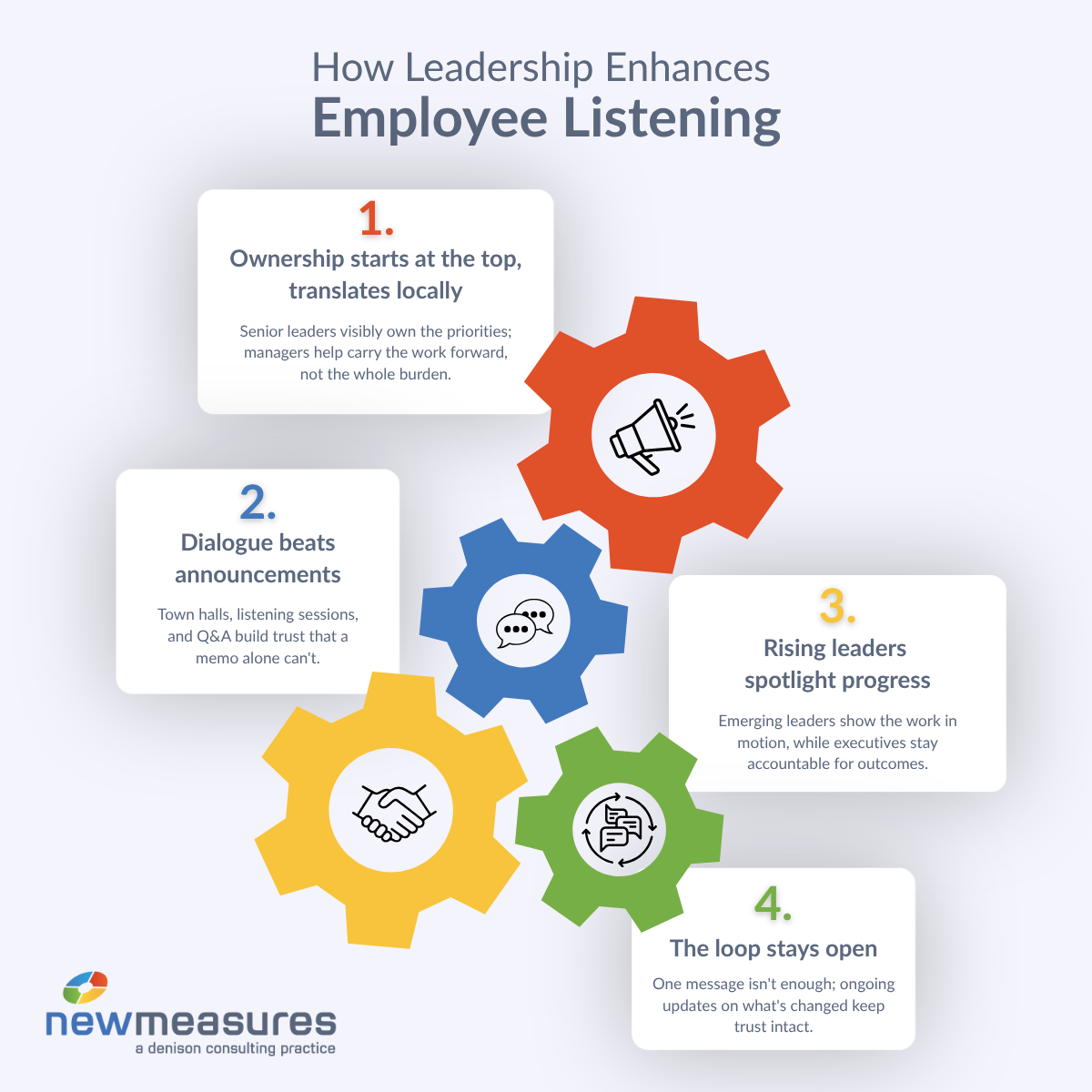
CEO and senior executive involvement matters because it signals that employee experience is a business priority. It communicates that engagement is not owned only by HR, an engagement action team, or individual managers. It is part of how the organization operates and succeeds.
The most effective post survey communications are often personable, values driven, and connected to the business. Leaders acknowledge what employees shared, explain why the feedback matters, and connect priorities to the organization’s strategy and commitments. This helps employees see that improving their experience is not separate from performance. It is part of the work.
This does not mean executives need to have every answer immediately. In fact, employees are often more receptive to a candid message that says, “We heard several important themes. Here is what we are prioritizing, here is what we are still working to understand, and here is when you will hear from us again.” Credibility comes from clarity, honesty, and continued visibility.
- Ownership cannot stop at the manager level
Managers play an essential role in survey follow-up. They are closest to employees and often best positioned to facilitate conversations, make local improvements, and respond to team needs. But there is a real risk when action is framed as something that happens only below the executive level.
An employee may see that their direct manager cares and is taking the survey seriously, while still concluding that senior leaders do not. That disconnect can undermine even well-intentioned efforts. It can create the impression that leaders asked for feedback but shifted responsibility elsewhere once the results arrived.
Senior leaders need to own a meaningful set of enterprise priorities and actions. They should be visible in explaining what those priorities are, why they were selected, and how progress will be measured. Managers can then help translate that work locally, rather than carrying the entire burden of proving that the organization listened.
In other words, local action is important, but it is not a substitute for organizational accountability.

- Create opportunities for dialogue
Face-to-face communication is often the most credible format for meaningful dialogue. Town halls, leadership listening sessions, roadshows, and facilitated conversations give employees an opportunity to hear directly from senior leaders and respond in the moment. These settings make it easier for leaders to demonstrate humility, answer questions, and acknowledge what they do not yet know.
Written messages and videos are particularly useful tools for creating consistency, reaching a broad audience, and reinforcing key messages, but they are most effective when they support dialogue rather than replace it. It is important to note here that a video that feels overly polished or a written note that simply announces priorities can feel distant if employees have no way to ask questions or continue the conversation.
Even when live dialogue is not feasible for every employee, organizations can create avenues for participation through moderated questions, follow up discussions with managers, listening channels, or employee forums. Regardless of the format, communication should create opportunities for employees to engage rather, than simply receive, information.
- Use rising leaders to show action in motion
Many organizations are involving cohorts of rising leaders in strategic business priorities and work including the employee experience. This can be a powerful way to build leadership capability and bring a fresh perspective to action planning.
Featuring rising leaders who are helping advance a corporate action can be a compelling example of progress. It gives employees a visible connection to the work and shows that the organization is developing leaders who understand the importance of employee experience.
Carefully position the rising leaders as those helping move the work forward, not as the group to whom senior leaders have transferred ownership. Senior leaders can publicly endorse the leaders and the work while making clear that they remain accountable for the priorities, resources, and outcomes. This reinforces both leadership development and executive commitment to the employee experience.
- Keep the communication loop open
A single post-survey message is never enough. Trust grows when employees see a consistent rhythm of communication and action over time.
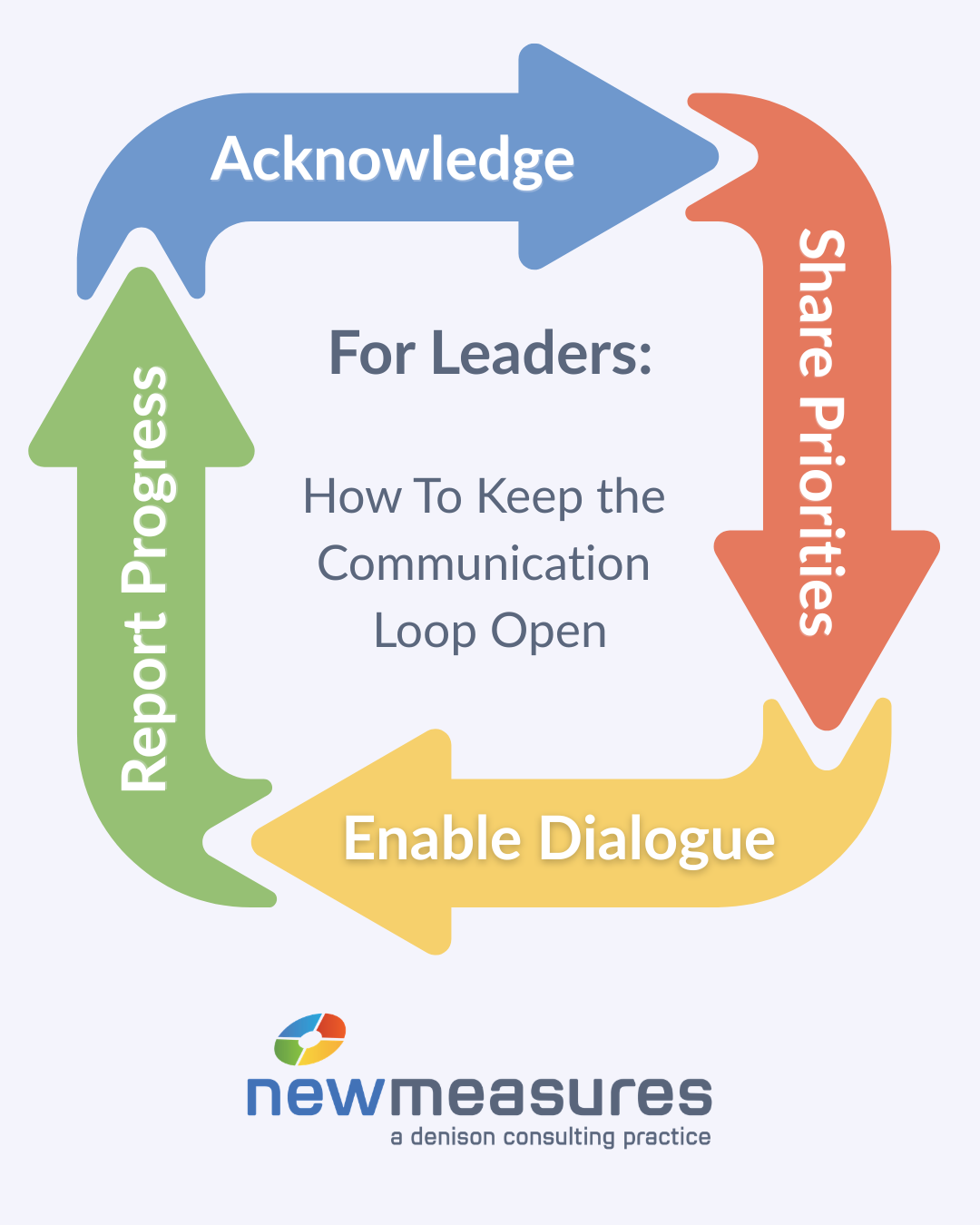
Start by acknowledging what was heard, then share the priorities that emerged and explain how action ownership is structured. Create opportunities for employees to engage in conversation then return with progress updates, including what has changed, what is still underway, and where the organization is learning.
Employees do not expect every concern to be solved at once. They expect leaders to take their feedback seriously and remain present after the survey closes.
The survey is where employees speak. What leaders do next determines whether employees believe they were truly heard.

Genicia Corney
Insights Consultant & Organizational Psychologist
Genicia is passionate about employee-centered organizational effectiveness. She leverages her previous leadership and operations experience to inform practical solutions for modern organizational challenges. Connect with Genicia at: LinkedIn.