Using AI to Analyze Employee Survey Data: Best Practices for Listening Leaders
Molly Weisshaar, Director, Employee Listening Team
AI tools can help organizations explore employee survey results more quickly, identify patterns, summarize themes, and generate new questions for consideration. However, before uploading survey data into a tool such as Claude, ChatGPT, or another AI platform, listening leaders should take time to consider confidentiality, employee trust, governance requirements, and data handling practices.
Start With the “Why”
Before choosing a tool, clarify the business question you are trying to answer.
Ask yourself:
What are you trying to learn?
Does your listening technology already have the tool to find the answer?
Do you need respondent-level data, or would dashboard summaries answer the question?
Are you looking for themes, patterns, trends, or recommendations?
In many cases, leaders can answer their questions using existing survey dashboards, heat maps, favorability scores, benchmark comparisons, or summarized comment reports without introducing additional confidentiality risk.
“Use the least sensitive data source that can effectively answer the question.”
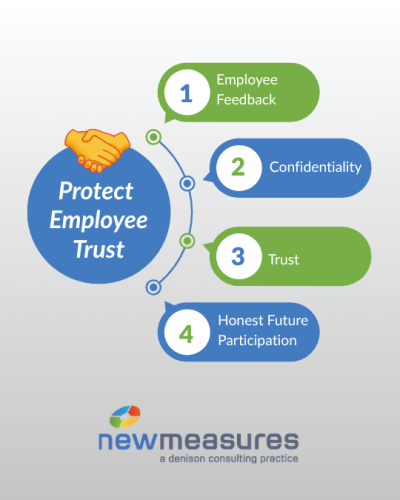
Protect Employee Trust
Trust is one of the most important assets in any employee listening program. Decisions about AI use should support, not undermine, that trust.
If employees were told their responses would only be reported in aggregate, that commitment matters. Uploading raw survey data into an AI tool without appropriate safeguards can create tension with those expectations, especially if individual responses could become identifiable.
Questions to consider:
Does this use align with what employees were told about confidentiality?
Could the analysis expose individual-level information?
If yes, would exposure change how employees feel about participating honestly in future surveys?
Minimize Identifying Information
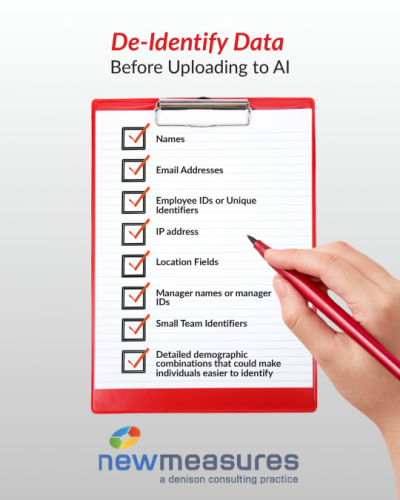
If raw data must be exported for further analysis, remove direct and indirect identifiers wherever possible.
Depending on the dataset, this may include:
Names
Email addresses
Employee IDs or unique identifiers
IP address or location fields
Manager names or manager IDs
Small-team identifiers
Detailed demographic combinations that could make individuals easier to identify
Even when direct identifiers are removed, combinations of demographic attributes can sometimes increase the likelihood of re-identification, particularly within small populations.
Use Threshold-Protected Outputs First
Whenever possible, begin with outputs that already respect confidentiality thresholds.
Many survey platforms provide exports, reports, and dashboards that aggregate results and suppress reporting for groups below minimum size thresholds. These outputs often provide sufficient information to identify patterns and opportunities while reducing the risk of exposing individual responses.
In many situations, aggregated results can answer the business question without requiring access to respondent-level data.
Understand the Governance Implications
It is likely that your organization has clear internal guidance on appropriate uses of AI. Before uploading any data be sure to review guidelines concerning:
Which AI tools are approved
What types of employee data may be uploaded
Who is allowed to access and analyze the data
How outputs will be used and stored
If these policies are not already in place, this is a good moment to establish them.
Be Clear About Ownership and Responsibility
Even when an organization owns its survey data, ownership alone does not determine appropriate use.
Leaders should consider not only what is technically possible, but also what is responsible, consistent with organizational values, and aligned with commitments made to employees.
The goal should be to balance insight generation with thoughtful stewardship of employee feedback.
Maintain Privacy
Where possible, privacy protections should be considered at the beginning of the survey process rather than only at the point of analysis. Building privacy protections upstream makes later decisions much easier.
Approaches such as pseudonymization, access controls, and data minimization can make later analysis decisions easier and help reduce risk throughout the survey lifecycle.
Use AI As a Tool, Not a Decision-Maker
AI can be valuable for identifying themes, highlighting patterns, summarizing comments, and generating hypotheses for further exploration.
However, AI-generated outputs should be viewed as starting points rather than definitive conclusions.
Leaders should apply human judgment, organizational context, and additional validation before making decisions based on AI-generated insights.
Bottom line
AI can be a helpful tool for analyzing employee feedback, but it should be used thoughtfully and responsibly. Start with the business question, use the least sensitive data necessary, follow organizational governance requirements, and ensure confidentiality commitments remain intact.
When in doubt, prioritize employee trust. The long-term success of any employee listening program depends not only on the insights generated, but also on employees’ confidence that their feedback will be handled responsibly.
“When in doubt, prioritize employee trust.”
Molly Weisshaar Director, Employee Listening Team
Molly is passionate about helping people deeply hear one another. She strives to use data as a way to elevate an organization’s understanding of strengths and opportunities without erasing the “humanness” of the experience. At Newmeasures, Molly collaborates with clients to activate on customized solutions that support the organization’s needs. Connect with Molly at Linkedin.